ECDIS Generic (Transas) (fysisk)
23-11-2026 SIMAC, Svendborg
Kurset ECDIS Generic giver kursisten en grundlæggende forståelse af fordele og begrænsninger i ECDIS, og en viden om styringen af vedligeholdelsen af et sådant
Within automation and electricity, SIMAC Training offers the following courses upon request.
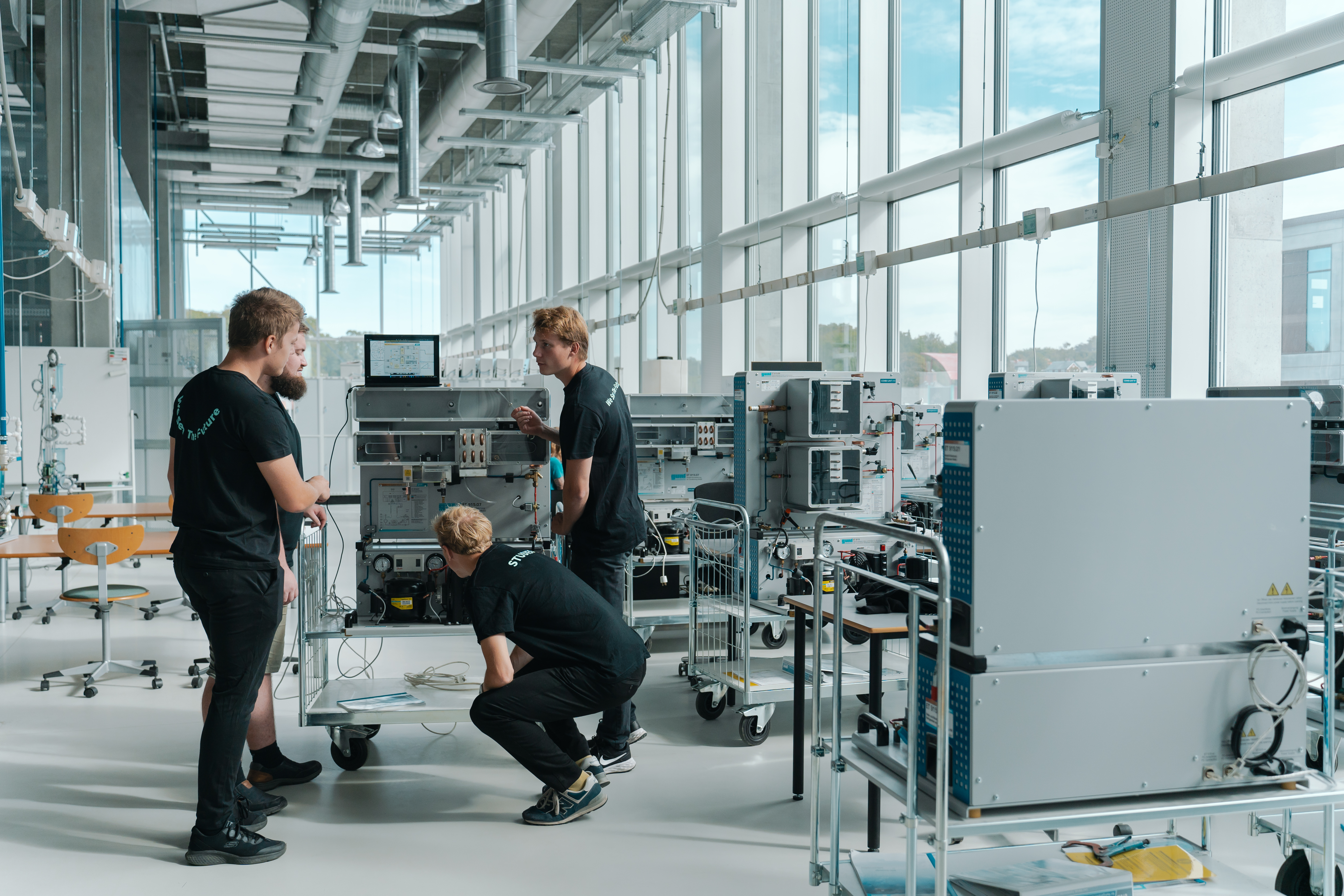
Within engine, automation and electricity, SIMAC Training offers the following standard courses.
You are welcome to contact SIMAC Training if you would like to discuss the possibility of a tailored course based on your specific needs within the automation field.
Purpose and Course Content
This course provides participants with a fundamental understanding of PLC principles and machine control systems.
Participants learn how a basic PLC system is structured, how to use programming software and tools, and gain a broad introduction to machine control. The course develops competencies related to the operation, maintenance, and troubleshooting of integrated control systems.
Upon completion, participants will have knowledge of:
PLC programming and program documentation
Using PLC programming software
Troubleshooting PLC-controlled systems
Performing Factory Acceptance Testing (FAT)
Performing Site/System Acceptance Testing (SAT)
Target Group
This course is designed for professionals who work with PLC systems and industrial automation.
Duration
1 day
Purpose and Course Content
The PLC, Profibus and OPC/SCADA Technology course qualifies participants to safely handle fieldbus networks and use data exchange in OPC/SCADA systems.
During the course, participants gain knowledge of maintenance, troubleshooting, data exchange, and the configuration of interfaces (HMI and SCADA).
Upon completion of the course, participants will have a solid understanding of the configuration and operation of PLCs in networked environments. Participants will also gain an understanding of the fundamental principles and configuration of fieldbus systems and operator panels and will be able to make program modifications and perform troubleshooting in industrial automation solutions with distributed I/O.
The PLC, Profibus and OPC/SCADA course is intended for service personnel involved in the operation, maintenance, troubleshooting, or running of PLC-controlled equipment.
Entry Requirements/Target Group:
Participants should have completed the PLC in Machine Control course or otherwise acquired equivalent competencies.
Duration:
3 days
Purpose and Course Content:
The SRO Systems course provides participants with a broad and fundamental understanding of process automation involving the control, regulation, and monitoring of SRO systems, while also updating them on developments within process automation.
Upon completion of the course, participants will understand the structure and operation of SRO systems and will have gained a solid understanding of relevant terminology and principles. Participants will also develop a general understanding of the application of SRO systems for the control and regulation of process engineering installations.
Entry Requirements/Target Group:
The course is intended for operations personnel, marine engineers, engineers, electricians, and similar professional groups with no prior knowledge or only limited experience with SRO systems.
Duration:
2 days
Purpose and Course Content
The Control and Regulation in SRO Systems course provides participants with a thorough understanding of both the practical and theoretical aspects of control engineering in SRO systems.
The course covers general topics, giving participants broad knowledge, and the training is based on facilities automated with modern integrated automation systems.
Upon completion of the course, participants will have acquired the competencies necessary to assume operational responsibility for process plants.
Entry Requirements/Target Group:
The course is intended for operations personnel, marine engineers, engineers, and similar professional groups with little or no prior knowledge of control engineering.
Participants should have completed the SRO Systems course or otherwise acquired equivalent competencies.
Duration:
2 days
Purpose and Course Content
The purpose of this course is to provide an in-depth understanding of practical measurement and troubleshooting on maritime electrical installations.
When performing measurements on live electrical systems, the course places particular emphasis on safety during troubleshooting, including the correct use and wearing of personal protective equipment (PPE) and the proper use of electrical test instruments. The course is based on control and main power circuit diagrams, including both complete and incomplete documentation, as well as the design and assembly of small control panels.
Entry Requirements/Target Group:
Electricians and marine engineers.
Duration:
2 days
Purpose and Course Content
The purpose of this course is to provide an in-depth understanding of basic electrical engineering through the application of Ohm’s Law. The course includes a thorough review of voltage, current, and resistance, using practical analogies to support understanding.
The course covers the following topics:
Fundamental electrical engineering principles
The history and background of electrical engineering
The concepts of electric current, voltage, and resistance
The difference between DC and AC
The construction of batteries (lead-acid and lithium accumulators)
The hazards of working on live electrical systems
Protection of electrical installations
First aid in the event of electrical accidents
A practical exercise related to working on live electrical systems
Entry Requirements/Target Group:
No prior knowledge or qualifications are required to participate in the course.
Duration:
1 day
Purpose and course content:
The purpose of the Proficiency in Engine Operations course is to provide participants with the theoretical knowledge and practical skills required for the safe and responsible operation, handling and maintenance of small marine engines and associated technical systems.
The course focuses on the operation of machinery with a power output of less than 750 kW on board vessels where engine-room manning is not required.
The course combines preparatory self-study with theoretical instruction and practical exercises in SIMAC’s Engine Lab.
The course covers the following topics:
Engine design, main components and functions
Engine operating principles and associated technical systems
Electrical installations on board
Routine inspection and maintenance of machinery
Safe start-up, operation and shutdown of engines
Fire prevention, firefighting and bilge systems
Protection of the marine environment
Entry requirements/target group:
The course is designed for seafarers who need to obtain or upgrade their qualifications in engine watchkeeping and the operation of small marine engines.
The course is particularly relevant to individuals who already hold marine engineering qualifications with a lower power output limitation and need to upgrade these qualifications to meet their operational responsibilities.
Any applicable entry requirements and existing qualifications are assessed in consultation with SIMAC Training prior to the course.
Duration:
Preparatory self-study + 1 day of on-site training.
Course Objective and Content:
The purpose of the Engine Room Team Management (ERTM) course is to introduce the key principles of resource management and provide a training environment that develops competencies to improve operational safety and efficiency on board ships.
Upon completion of the course, participants will have increased their knowledge, understanding, and awareness of the importance of human factors in ship operations.
Participants will also have strengthened their foundation for applying and developing leadership skills, both during routine operations and in critical situations. Furthermore, participants will gain specific tools to improve teamwork, communication, leadership, decision-making, and resource management, along with an understanding of how these ERTM skills contribute to redundancy and enhanced safety.
The course combines theoretical presentations with supervised training in a Full Mission Engine Room Simulator, where participants engage in a series of scenarios of varying complexity. Depending on the participants' experience, exercises can be conducted using either two medium-speed engine simulators or a slow-speed MAN B&W engine simulator.
Specific exercises, scenarios, and simulator configurations are adapted to the participants' professional experience.
The course covers the following topics:
Engine Room Team Management (ERTM)
Resource management
Near misses and accidents
Communication methods, perception, and questioning techniques
Team balance, assertiveness, and flexibility
Effects and signs of stress
Situational awareness and decision-making
Planning principles and practical planning
Effective communication
Leadership functions
Admission Requirements / Target Group:
The course is intended for marine engineers and dual-qualified officers employed in the shipping or offshore industries.
Participants must have prior knowledge of engine room operations.
Duration:
3 days
Remarks / Notes:
Appropriate clothing, a change of clothes, and suitable footwear are required, as training takes place in a warm and noisy simulator environment with steep stairways.
The course complies with the standards set out in STCW Convention Tables A-III/1 and A-III/2, including the Manila Amendments.
Registration:
Please contact SIMAC Training directly for information about available course dates at Training@simac.dk
Course Objective and Content:
The purpose of the Engine Room Team Management (ERTM) course is to introduce the key principles of resource management and provide a training environment that develops competencies to improve operational safety and efficiency on board ships.
Upon completion of the course, participants will have increased their knowledge, understanding, and awareness of the importance of human factors in ship operations.
Participants will also have strengthened their foundation for applying and developing leadership skills, both during routine operations and in critical situations. Furthermore, participants will gain specific tools to improve teamwork, communication, leadership, decision-making, and resource management, along with an understanding of how these ERTM skills contribute to redundancy and enhanced safety.
The course combines theoretical presentations with supervised training in a Full Mission Engine Room Simulator, where participants engage in a series of scenarios of varying complexity. Depending on the participants' experience, exercises can be conducted using either two medium-speed engine simulators or a slow-speed MAN B&W engine simulator.
Specific exercises, scenarios, and simulator configurations are adapted to the participants' professional experience.
The course covers the following topics:
Engine Room Team Management (ERTM)
Resource management
Near misses and accidents
Communication methods, perception, and questioning techniques
Team balance, assertiveness, and flexibility
Effects and signs of stress
Situational awareness and decision-making
Planning principles and practical planning
Effective communication
Leadership functions
Admission Requirements / Target Group:
The course is intended for dual-qualified officers and deck officers serving on all types of vessels.
Participants must have previously completed and passed an ERM/ERTM course. A copy of the certificate must be sent to sikkermail@simac.dk no later than one week before the course starts.
Duration:
1 day (Online)
Sharing of Information:
The email address provided during registration will be shared with the other participants on the course.
Remarks / Notes:
The course complies with the standards set out in STCW Convention Tables A-II/1 and A-II/2, including the Manila Amendments.
Participants must have access to a computer with a microphone and camera, as well as a stable internet connection.
Registration:
For information about available dates for the full ERM course (3 days), please contact SIMAC Training directly at:
Registration for the ERM Refresher course (1 day):
Purpose and Course Content:
The purpose of the Operation and Watchkeeping – Engine Room Systems course is to qualify participants to perform the duties of an Officer in Charge of an Engineering Watch, as specified in the STCW Code.
Upon completion of the course, participants will have acquired the knowledge and competencies required to perform the duties of an engineering watch officer, including an understanding of various voyage scenarios, effective communication, and teamwork.
The course is practice-oriented. Working in small groups, participants complete a range of operational scenarios in the simulators, which are subsequently reviewed and analysed during debriefing sessions in relation to the exercise outcomes and accepted industry practice.
Training is conducted primarily in SIMAC’s full-mission engine room simulator. SIMAC also provides a range of graphical simulators that may be used to prepare participants for upcoming exercises in the full-mission engine room simulator.
The course covers the following topics:
Duties of the Officer in Charge of an Engineering Watch
Operation of main and auxiliary engines under normal and abnormal conditions
Troubleshooting and fault diagnosis
Use of the Oil Record Book and the Chief Engineer’s logbook
Watch handover procedures
Entry Requirements/Target Group:
The course is intended for newly qualified marine engineers and for marine engineers who have been away from the maritime industry for a period of time and require an update on engine room operations and watchkeeping.
Duration:
2.5 days
Notes:
The course fulfills the requirements specified in the Watchkeeping Regulations and in the STCW Code, Section A-III/1 – Standards of Competence, with regard to the safe conduct of an engineering watch and the associated duties related to the operation and supervision of main and auxiliary machinery.
Registration
For course dates, please contact SIMAC Training directly at training@simac.dk.
23-11-2026 SIMAC, Svendborg
Kurset ECDIS Generic giver kursisten en grundlæggende forståelse af fordele og begrænsninger i ECDIS, og en viden om styringen af vedligeholdelsen af et sådant
25-11-2026 SIMAC, Svendborg
BRM/BTM refresher - online
01-12-2026 Online kursus/course via MS Teams
Gennem kurset “§6- Passagersikkerhed, last-sikkerhed og skrogintegritet” får kursisten viden om stabilitet i forhold til passagersikkerhed, lastsikkerhed og skrogintegritet.
02-12-2026 Online kursus/course via MS Teams
På kurset §5 Krisestyring og menneskelig adfærd lærer kursisten om styring af krise- og nødsituationer til søs.
04-12-2026 Online kursus/course via MS Teams
“§7 Tilrettelæggelse og afvikling af båd- og brandøvelser” lærer kursisten at tilrettelægge og afvikle maritime båd- og brandøvelser i relation til brandslukning, evakuering og redningsmidler.
07-12-2026 SIMAC, Svendborg
IGF Basic-kurset er et grundlæggende, men omfattende kursusprogram, der er designet til søfarende, teknikere og maritime fagfolk, som arbejder med eller omkring skibe, der drives af alternative brændstoffer.
14-12-2026 Online kursus/course via MS Teams
The Dangerous Goods course imparts knowledge to the participant in the transport of dangerous goods at sea.
06-01-2027 Online kursus/course via MS Teams
Duration; 1 day (+ own preparation / self study).
18-01-2027 SIMAC, Svendborg
VTS Basic Operator training based on the IALA Model Course V103-1.
19-01-2027 Online kursus/course via MS Teams
Gennem kurset “§6- Passagersikkerhed, last-sikkerhed og skrogintegritet” får kursisten viden om stabilitet i forhold til passagersikkerhed, lastsikkerhed og skrogintegritet.
20-01-2027 Online kursus/course via MS Teams
På kurset §5 Krisestyring og menneskelig adfærd lærer kursisten om styring af krise- og nødsituationer til søs.
22-01-2027 Online kursus/course via MS Teams
“§7 Tilrettelæggelse og afvikling af båd- og brandøvelser” lærer kursisten at tilrettelægge og afvikle maritime båd- og brandøvelser i relation til brandslukning, evakuering og redningsmidler.
25-01-2027 Online kursus/course via MS Teams
SIMAC Training har udviklet et onlinekursus i Advanced Oil Tanker og Advanced Chemical Tanker, som gennemføres via den cloudbaserede Liquid Cargo Handling Simulator Transas LCHS 5000.
01-02-2027 SIMAC, Svendborg
Formål og kursusindhold: Generelt certifikat som radiooperatør i GMDSS (GOC) generhvervelse. Kurset afsluttes med en individuel mundtlig eksamen. Deltagerne bliver bedømt bestået/ikke bestået. Varighed af eksaminationen er ca. 45 min
08-02-2027 Online kursus/course via MS Teams
Kurset introducerer dig til sejlads i isfyldt farvand og opdateres løbende i henhold til de nyeste nationale og internationale krav. The course introduces you to sailing in ice-filled waters and is continuously updated in accordance with the latest
10-02-2027 SIMAC, Svendborg
Advanced Polar Course, retter sig mod skibsførere, overstyrmænd og andre navigationsofficerer, som arbejder på skibe der opererer i polare farvande omfattet af Polar kodens bestemmelser. The Advanced Polar Course is aimed at masters, chief mates, an
15-02-2027 SIMAC, Svendborg
Formålet med kurset “Bridge Team Management, Refresher” er at genopfriske de centrale principper inden for ressourcestyring og styrke deltagernes kompetencer med henblik på at øge den operationelle sikkerhed og effektivitet om bord på skibe.
18-02-2027 SIMAC, Svendborg
Ship Handling Basic and Ship Handling Refresher runs concurrently, you select the course version from the dropdown menu after clicking "start registration."
25-02-2027 Online kursus/course via MS Teams
Kurset introducerer dig til den grundlæggende teori om olie-, gas- og kemikalietankskibsoperationer.
01-03-2027 Online kursus/course via MS Teams
Gennem Farligt Gods og Østersøaftalen kursus, får kursisten viden om transport af farligt gods til søs.
08-03-2027 SIMAC, Svendborg
Kurset ECDIS Generic giver kursisten en grundlæggende forståelse af fordele og begrænsninger i ECDIS, og en viden om styringen af vedligeholdelsen af et sådant
08-03-2027 Online kursus/course via MS Teams
Duration; 1 day (+ own preparation / self study).
08-03-2027 SIMAC, Svendborg
IGF Basic-kurset er et grundlæggende, men omfattende kursusprogram, der er designet til søfarende, teknikere og maritime fagfolk, som arbejder med eller omkring skibe, der drives af alternative brændstoffer.
16-03-2027 SIMAC, Svendborg
Gennem kurset “§6- Passagersikkerhed, last-sikkerhed og skrogintegritet” får kursisten viden om stabilitet i forhold til passagersikkerhed, lastsikkerhed og skrogintegritet.
17-03-2027 SIMAC, Svendborg
På kurset §5 Krisestyring og menneskelig adfærd lærer kursisten om styring af krise- og nødsituationer til søs.
19-03-2027 SIMAC, Svendborg
“§7 Tilrettelæggelse og afvikling af båd- og brandøvelser” lærer kursisten at tilrettelægge og afvikle maritime båd- og brandøvelser i relation til brandslukning, evakuering og redningsmidler.
22-03-2027 SIMAC, Svendborg
Formålet med kurset “Engine Room Team Management - Refresher” er at genopfriske hovedemnerne ved ressourcestyring og at tilbyde et uddannelsesmiljø, der udvikler kompetencer til at forbedre den operationelle sikkerhed og effektivitet på skibe.
19-04-2027 SIMAC, Svendborg
Formål og kursusindhold: Generelt certifikat som radiooperatør i GMDSS (GOC) generhvervelse. Kurset afsluttes med en individuel mundtlig eksamen. Deltagerne bliver bedømt bestået/ikke bestået. Varighed af eksaminationen er ca. 45 min
03-05-2027 SIMAC, Svendborg
Formålet med kurset “Bridge Team Management, Refresher” er at genopfriske de centrale principper inden for ressourcestyring og styrke deltagernes kompetencer med henblik på at øge den operationelle sikkerhed og effektivitet om bord på skibe.
10-05-2027 Online kursus/course via MS Teams
Duration; 1 day (+ own preparation / self study).
25-05-2027 Online kursus/course via MS Teams
Gennem kurset “§6- Passagersikkerhed, last-sikkerhed og skrogintegritet” får kursisten viden om stabilitet i forhold til passagersikkerhed, lastsikkerhed og skrogintegritet.
26-05-2027 Online kursus/course via MS Teams
På kurset §5 Krisestyring og menneskelig adfærd lærer kursisten om styring af krise- og nødsituationer til søs.
28-05-2027 Online kursus/course via MS Teams
“§7 Tilrettelæggelse og afvikling af båd- og brandøvelser” lærer kursisten at tilrettelægge og afvikle maritime båd- og brandøvelser i relation til brandslukning, evakuering og redningsmidler.
31-05-2027 SIMAC, Svendborg
IGF Basic-kurset er et grundlæggende, men omfattende kursusprogram, der er designet til søfarende, teknikere og maritime fagfolk, som arbejder med eller omkring skibe, der drives af alternative brændstoffer.
07-06-2027 Online kursus/course via MS Teams
Gennem Farligt Gods og Østersøaftalen kursus, får kursisten viden om transport af farligt gods til søs.
14-06-2027 SIMAC, Svendborg
Kurset ECDIS Generic giver kursisten en grundlæggende forståelse af fordele og begrænsninger i ECDIS, og en viden om styringen af vedligeholdelsen af et sådant
21-06-2027 SIMAC, Svendborg
Formål og kursusindhold: Generelt certifikat som radiooperatør i GMDSS (GOC) generhvervelse. Kurset afsluttes med en individuel mundtlig eksamen. Deltagerne bliver bedømt bestået/ikke bestået. Varighed af eksaminationen er ca. 45 min
05-07-2027 Online kursus/course via MS Teams
SIMAC Training har udviklet et onlinekursus i Advanced Oil Tanker og Advanced Chemical Tanker, som gennemføres via den cloudbaserede Liquid Cargo Handling Simulator Transas LCHS 5000.